A practical route through interviews, survey responses and public discussion with SAM.
Start with a research question. Explore across a corpus. Return to the accounts and situations that give a pattern meaning. This guide brings those movements together through two worked teaching examples: interview excerpts about experiences of care, and a bounded YouTube Comments collection.
Read the guide
Pages
Frame a question and preserve context
02-03
Work closely with interview accounts
04-07
Explore YouTube comments with SAM Collect
08-11
Connect patterns, pathways and source records
12-13
Prepare an accountable report
14-15
Continue learning and explore sources
16
Teaching edition 1.0 · 18 October 2026. Interview excerpts and illustrative comments are fictional; product screenshots show the current interface. The accompanying files retain those labels.
SAM Social Analysis of MeaningBIGQUALDATALABS
01 / Research design
Begin with the question.
Choose the material and the scale of reading together.
Big Qual work can move between the breadth of a large collection and the depth of a situated account. A useful starting question makes both movements possible: what would you need to compare across records, and what would you need to understand within a case?
Setting
A question to develop
Health and care evaluation
How do people describe being heard and navigating the next stage of care?
HR and employee experience
How do accounts of support vary across roles, work patterns and stages of employment?
Policy and public services
How are needs framed in lived accounts, public discussion and institutional responses?
Write a short analysis brief
01
State the purpose and intended readers of the work.
02
Name the source, time window, selection process and unit of analysis.
03
Explain how you will select records for close reading and revisit exceptions.
04
Decide what evidence would support a claim, and what the material cannot establish.
The breadth-and-depth tradition connects broad exploration, purposive selection and fuller interpretation of cases. The NCRM resources on page 16 offer methodological grounding. SAM provides workspaces for carrying out and documenting these analytical choices.
SAM Social Analysis of MeaningBIGQUALDATALABS
01 / Research design
Keep the case in view.
A record is an analytical unit. Its context may extend beyond one row.
Prepare a working copy of your material. Retain stable identifiers and a route back to the original source. For interviews, keep the interview or case identifier beside each excerpt. For surveys, preserve the question wording and the response identifier. For public discussion, retain the source URL and collection date.
Keep alongside the text
Why it helps
Record and case identifiers
Move from a coded excerpt to the wider account.
Question or conversation context
Interpret what the response is responding to.
Dates and their meaning
Distinguish publication, collection, event and interview dates.
Selection and transformation notes
Explain exclusions, splitting, cleaning and missing material.
For sensitive material, use the access, consent, anonymisation and retention arrangements agreed for your project. Review the actual deployment and account arrangements before uploading. Prepare teaching material separately from working research data.
SAM Social Analysis of MeaningBIGQUALDATALABS
02 / Interview example
Read an account closely.
Worked example: experiences of access, listening and coordination.
The companion CSV contains 24 fictional excerpts from 12 invented interviews. Each interview has two excerpts and a stable case identifier. Use it to practise the workflow, then adapt the research question and codebook to your own study.
Each person was kind, but I seemed to be the one carrying information between services.
SYN-CARE-07-A · fictional teaching excerpt
Once a named contact was given to me, it became much easier to ask where things stood.
SYN-CARE-07-B · the same fictional interview
First reading
Together, the excerpts suggest a distinction between interpersonal kindness and coordination across services. A first memo might ask who is doing the work of connecting information, and what changes when a named contact becomes available.
In SAM, upload the teaching CSV, select the text column and preserve interview_id in the dataset. Open Classic Coding and read each excerpt alongside the other excerpt from that case. Record your initial questions before applying a broad coding scheme.
SAM Social Analysis of MeaningBIGQUALDATALABS
02 / Interview example
Make the codebook useful.
Definitions guide decisions; boundary notes make them discussable.
Start with a small set of codes linked to the question. The companion codebook offers five candidates. You can revise, combine or replace them as the analysis develops.
Code
Working definition
Being heard
An account of having, or seeking, space for an experience to be recognised.
Practical access
Arrangements that shape whether and how a person can participate.
Continuity and coordination
Connections between people, information and stages of care.
Navigating uncertainty
Accounts of making sense of an unresolved explanation or next step.
Self-advocacy
Work a person describes doing to make their account or needs visible.
A worked decision
SYN-CARE-07-A can receive Continuity and coordination because the speaker describes carrying information between services. Self-advocacy is a possible second reading, but the excerpt does not say that they challenged a decision or actively pressed for a need. Keep that distinction in the boundary note.
In Classic Coding, use Qualitative and review Codes and scheme. Choose a preset, your custom codes, or a combined scheme. Add definitions or upload a codebook using the current sample format. Review any mapping of extra columns, and keep the complete original codebook with the project.
SAM Social Analysis of MeaningBIGQUALDATALABS
02 / Interview example
Compare readings and variation.
Use qualitative coding, sentiment and stance for distinct questions.
Excerpt
An analytical possibility
SYN-CARE-03-A: an evening appointment helped; the conversation felt rushed.
Practical access and Being heard can coexist. Preserve the mixed account.
SYN-CARE-09-B: one clear explanation was preferred to more messages.
Communication preferences differ; frequency alone may be a poor measure of support.
SYN-CARE-11-B: the visit allowed time; getting there was difficult.
Compare the encounter with the arrangements that enabled attendance.
Sentiment and stance
Sentiment addresses evaluative tone using the selected scheme. Stance addresses a position towards an explicit target. For SYN-CARE-06-B, a stance lens could ask about keeping a telephone option alongside online forms. Define that proposition before choosing categories. Avoid inferring a position on the wider service from a narrow preference.
Extend the review in Adaptive Coding Studio
Bring the selected coding approach into the Studio. Review code definitions and records, develop learning examples, and examine a candidate profile on separate evaluation material. Approve the version you choose; then select its application scope and inspect the resulting coding.
SAM Social Analysis of MeaningBIGQUALDATALABS
02 / Interview example
Build an interpretation.
Move between recurring patterns, contrasting cases and full accounts.
Review excerpts grouped by code, then return to the interview pairs. Ask whether the same code describes different experiences. Practical access includes timing, travel, caring responsibilities and digital arrangements; each may have a different relationship to the encounter itself.
When I finally attended, the staff gave me time. The difficulty was getting there, rather than the conversation.
SYN-CARE-11-B · fictional teaching excerpt
An example analytical memo
Across the invented accounts, access and the experience of the consultation can vary independently. SYN-CARE-03-A describes convenient timing with a rushed conversation; SYN-CARE-11-B describes a helpful encounter after difficulty attending. These contrasts suggest examining the pathway into care as well as the encounter.
01
Gather the supporting and contrasting record IDs.
02
Read the surrounding account and preserve the speaker’s distinctions.
03
State the interpretation in terms of this material and this sampling design.
04
Export coded texts and the codebook; retain a memo explaining how the interpretation developed.
Results can provide further views of the corpus. Narrative Synthesis can help organise an account around evidence anchors; follow those anchors back to the source. Narrative Timeline needs usable dates and topic clustering. The undated teaching CSV is intended for close reading and synthesis, rather than a timeline.
SAM Social Analysis of MeaningBIGQUALDATALABS
03 / YouTube example
Define a bounded collection.
Worked example: condolence, solidarity and expectations of care.
A public video gives commenters a shared point of reference. Begin by watching or reading enough of that source to understand what the discussion responds to. Record the video, your question and the collection date before collecting comments.
The companion webinar example uses “Dealing with the death of a teammate // DOCTOR Covid-19 Vlog #31”. Its URL is https://www.youtube.com/watch?v=oQCgbNeoPl4. It provides a collection starting point; the examples on pages 10-11 are fictional comments written for teaching.
Record in the collection note
Example entry
Source and scope
YouTube Comments; one specified video URL.
Requested limit
Choose a limit supported by the current control, such as 100.
Date and return
Record when you collected, how many records returned and any visible gaps.
Context
Video title and URL; available reply or conversation information.
Comments are a self-selecting discussion around this video. Deleted, unavailable or unreturned material may be absent. A collection limit is a retrieval boundary, and a returned row is not automatically a distinct participant.
SAM Social Analysis of MeaningBIGQUALDATALABS
03 / YouTube example
Collect, review, then analyse.
Keep the collection step visible in the research record.
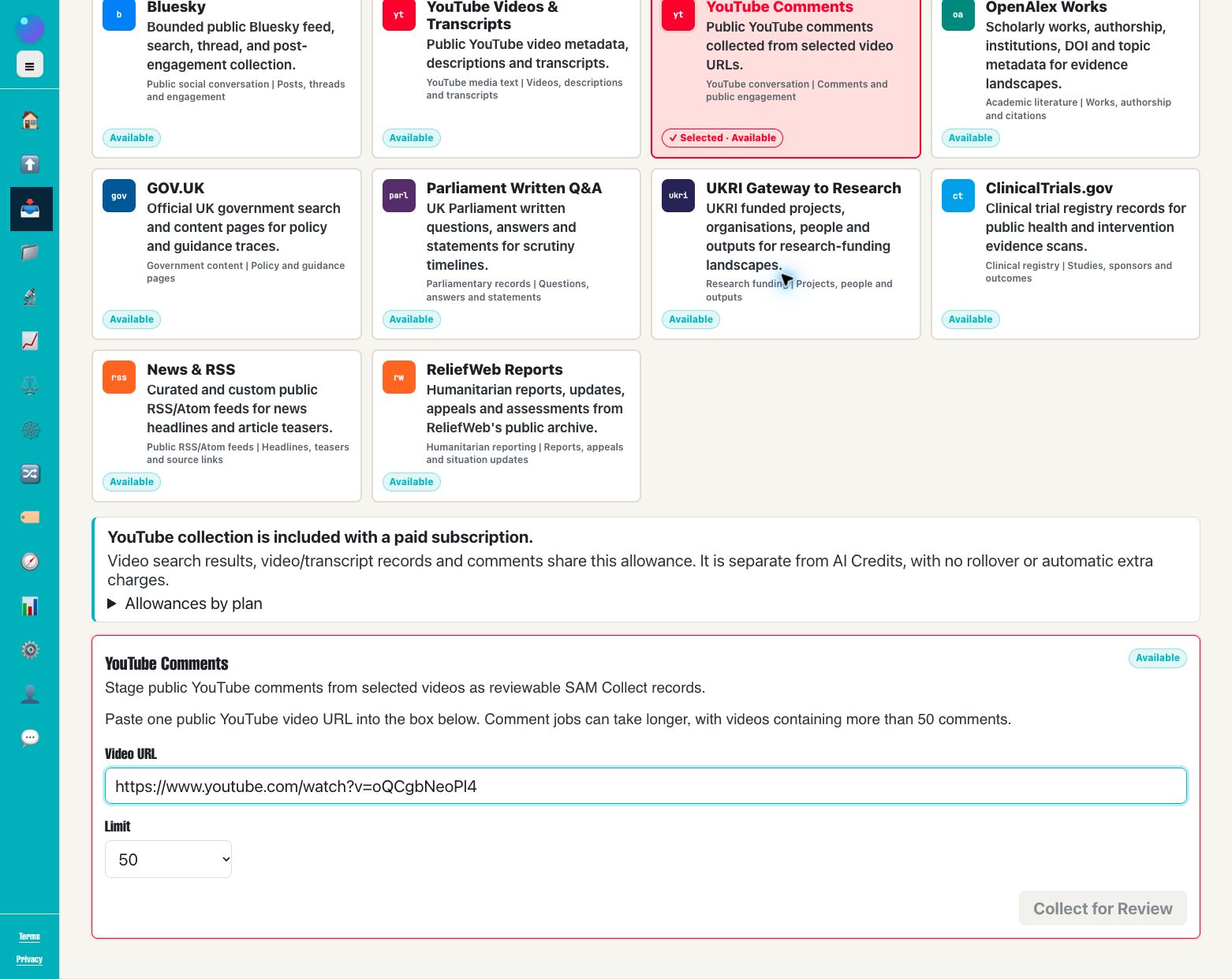
SAM Collect / YouTube Comments configuration, inspected 18 October 2026. This screenshot shows setup; no new collection was run for this guide.
01
Open SAM Collect and choose YouTube Comments. Enter one public video URL.
02
Choose the requested limit. The inspected interface offers 50, 100, 200, 500, 700 or 1,000. Check the account’s collection allowance.
03
Run Collect for Review when available, then inspect the returned records, source fields and gaps.
04
Use Save Snapshot to retain a selection, or Save to Analyse to add the material to My Corpora. Record what you retained.
YouTube Videos & Transcripts is a separate source choice. Use Comments for this question. If collection is unavailable, read the source status and allowance message before changing the design. Keep a durable project record of the provenance and selection: Collect displays a 30-day source-material notice.
SAM Social Analysis of MeaningBIGQUALDATALABS
03 / YouTube example
Read tone and position.
A warm message can also express a demand.
I am so sorry for your loss. Thank you for showing what your team is going through.
Fictional teaching comment A
Your colleagues deserve proper support after this. I hope the organisation makes time for them.
Fictional teaching comment B
Comment A offers condolence and recognition. Comment B combines concern with an expectation of organisational support. These are possible interpretations to discuss, rather than model answers.
Analytical view
What to make explicit
Sentiment
The scheme’s categories and the object or passage being evaluated. Sadness and appreciation may appear together.
Stance
The target proposition, such as “The organisation should provide support after staff bereavement.”
Qualitative coding
The meaning being interpreted, such as Condolence, Solidarity or Expectations of care.
Read a sample independently before comparing SAM’s reading with researcher coding. Where readings differ, inspect the text, the target and the code definitions. Preserve uncertainty when the comment is too brief or its reference is unclear.
SAM Social Analysis of MeaningBIGQUALDATALABS
03 / YouTube example
Follow meaning across comments.
Use broad patterns to choose the next close reading.
I keep thinking about the people who went home from that shift and had to explain it to their families.
Fictional teaching comment C
We had a very different experience where I work. I would like to know what support was offered afterwards.
Fictional teaching comment D
C may extend care to colleagues and families. D introduces comparison and a question about subsequent support. A codebook can record those differences instead of grouping every sympathetic response into one category.
01
Review a varied initial set: short and long responses, common language and less frequent perspectives.
02
Use Topics, sentiment or a relevant Results view to find areas for further reading. Check how the displayed grouping was produced.
03
Return to source text and available conversation context. Read references such as “that” or “afterwards” in relation to the video.
04
Revise code definitions, review affected records and export the coded material with a dated memo.
If your export retains reply relationships, use them when interpreting exchanges. If it does not, record that limit and inspect the source where appropriate. Do not reconstruct a conversation from row order alone.
SAM Social Analysis of MeaningBIGQUALDATALABS
04 / Connect the views
Let patterns guide the next reading.
A chart becomes useful when you can explain the records behind it.
View or tool
A productive next question
Topics and grouped codes
Which examples support this grouping, and which complicate it?
Sentiment and stance
What is being evaluated, and what explicit proposition is the position about?
Narrative Synthesis
Which source anchors support the proposed arc or account?
Narrative Timeline
What does the date field mean, and is there enough material in each period?
Tone of Voice and Framing
How is a concern expressed and represented in the source material?
Visual Coding
What do researcher-applied image tags add to the textual reading?
Choose views that answer the research question and are supported by the dataset. Preserve denominators: records, comments, interviews and people are different units. A code may occur more than once in a case, and a record may carry several codes.
For visual material, open the dedicated Visual Coding workspace in Results, or inspect the media galleries associated with Tone of Voice and Framing. Apply your own tags and inspect captions and images in context. Record how visual and textual readings informed each other.
SAM Social Analysis of MeaningBIGQUALDATALABS
04 / Connect the views
Compare sources with a clear purpose.
Related questions can connect materials with different evidential roles.
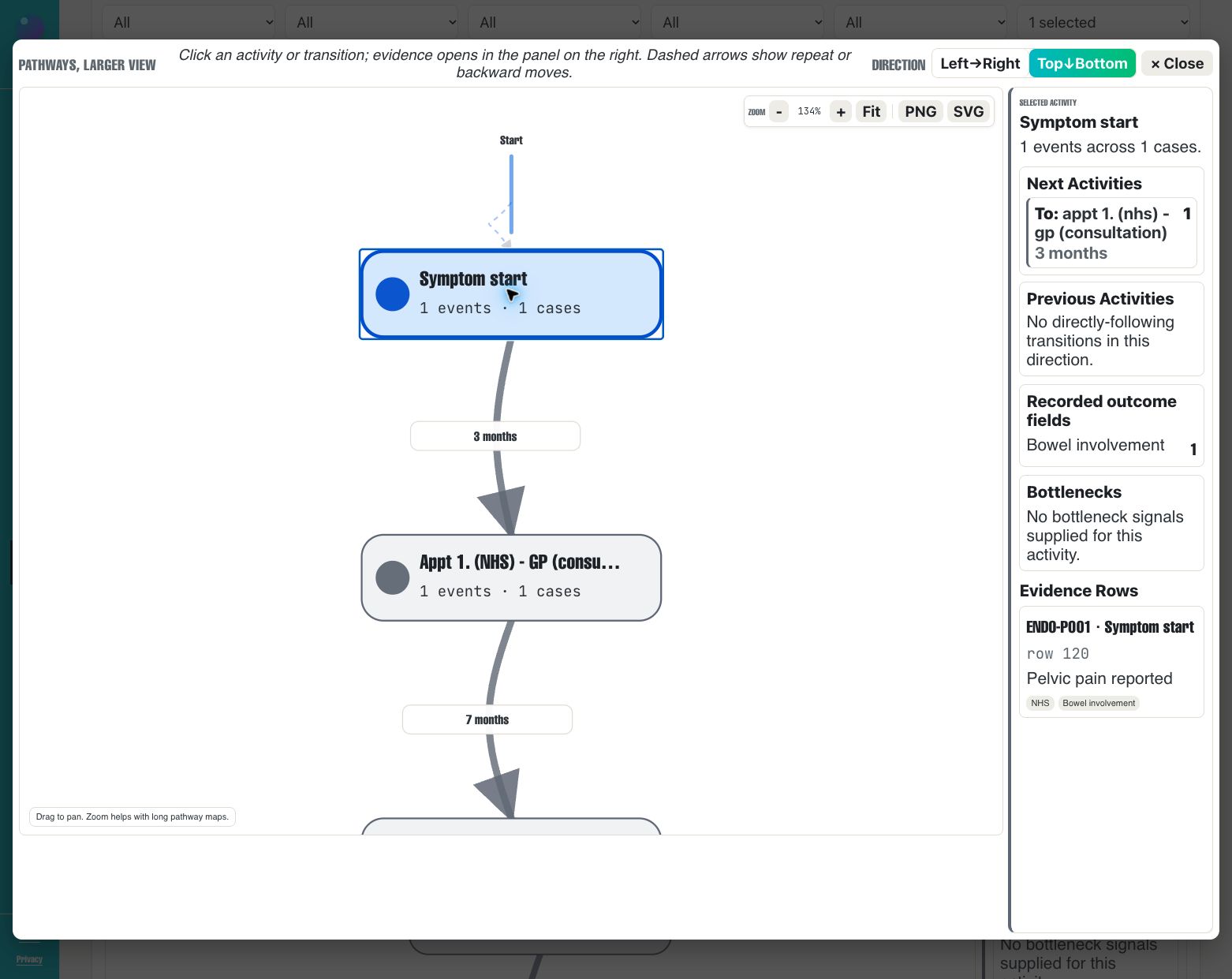
Detail from the built-in synthetic Endometriosis Diagnostic Delay sample: a selected event and its source evidence. The data represent fictional journeys.
Pathways can examine reviewed event sequences. Interviews can explore meanings and experiences. Parliament Written Q&A can show how an issue is raised and formally answered. OpenAlex Works and UKRI Gateway to Research can add publication and funded-project context.
Connection
Preserve this distinction
Pathways and interview analysis
Event sequences and accounts of experience answer related questions; link cases only where a legitimate shared identifier exists.
Public discussion and Parliament Q&A
Everyday expression, questions and institutional replies have different audiences and purposes.
Publications and funded projects
A publication record and a grant description represent different stages and types of activity.
SAM Social Analysis of MeaningBIGQUALDATALABS
05 / Reporting
Make the route to a claim visible.
Bring selection, coding and interpretation into the report.
A report element
What to retain
Material and scope
Source, time window, collection or upload date, selection and exclusions.
Units and counts
Cases, records, responses and coding decisions with their actual denominators.
Analytical approach
Research question, codebook, stance target, revisions and role of AI assistance.
Evidence
Supporting excerpts, contrasting cases and stable source identifiers.
Review
Who read what, conditions of independence, comparison and adjudication.
Exports and versions
Dataset version, coding export, codebook, profile version and dated analytical memos.
Use quality evidence precisely
Researcher agreement, AI performance against an adjudicated reference, and repeatability between AI runs answer different questions. Report the relevant sample, missing decisions and procedure with each measure. Use the method-contract version displayed with the project.
For a small study, individual comparisons and qualitative review may be the evidence you can support. If SAM marks the overall Coding Quality Score unavailable, describe the available evidence and the unmet requirements. Repeated readings of the same material do not create more distinct records.
SAM Social Analysis of MeaningBIGQUALDATALABS
05 / Reporting
A practical review checklist.
Use this before presenting an interpretation or sharing an export.
01
Question: can a reader see what the analysis was designed to understand?
02
Material: are sources, boundaries, dates, omissions and selection decisions recorded?
03
Context: can coded records be traced to the relevant case, question or source?
04
Definitions: are code boundaries, the sentiment scheme and any stance target explicit?
05
Variation: have you read contrasting cases and material that challenges the current interpretation?
06
Review: are researcher, AI-assisted and independent comparison activities described accurately?
07
Claims: do statements match the source, sample and units actually analysed?
08
Outputs: are excerpts, captions, identifiers and export versions checked for the intended audience?
Save a short decision trail
A useful memo can be a paragraph: the question at this stage; the material you inspected; the change in interpretation; the records supporting it; and the next reading you plan. Keep these notes with the codebook and exports.
SAM Social Analysis of MeaningBIGQUALDATALABS
Continue learning
Bring your material into view.
Use the guide alongside SAM’s samples, demonstrations and training.
Explore in SAM
Classic Coding introduces close reading, codebooks, sentiment and stance. Adaptive Coding Studio follows reviewed examples through learning, evaluation, approval, application and review. Explore both workflows in the product walkthroughs on the SAM website.
The Methods & Practice companion series connects a synthetic Pathways example, a separate interview teaching dataset, and a bounded Parliament collection. The in-app manual is prepared separately for future authenticated deployment.