
Building the wider evidence context with SAM Collect
18 October 2026 · Part 3 of 3
A question about experiences of care can also lead to institutional records. Parliament Written Q&A, research publications and funded-project descriptions offer different views of how an issue is discussed and investigated. SAM Collect provides a starting point for assembling bounded collections from these sources.
Give each source a role
The Pathways article examines fictional event sequences. The interview article explores a separate set of invented accounts. A Parliament collection can add the wording of questions and formal replies. OpenAlex Works can supply publication records; UKRI Gateway to Research can supply funded-project information. State what each adds to the research question before collecting it.
For this exercise, ask: How are diagnosis, access and continuing support framed in parliamentary questions and answers about endometriosis? This concerns the language and content of institutional documents. Claims about implementation or lived outcomes would require additional evidence.
Specify the collection in SAM
Open SAM Collect and choose Parliament. The inspected controls support a query, content choice, date range, date basis, matching mode, sort order and result limit, with further filters such as House and answer status.
One reproducible starting configuration is endometriosis, Written Q&A, exact phrase, newest first, a limit of 25, dates 1 January 2025 to 30 September 2026, using Answered/made as the date basis. Treat these as a proposed exercise boundary. No collection was executed for this article, so no return count or corpus finding is asserted.
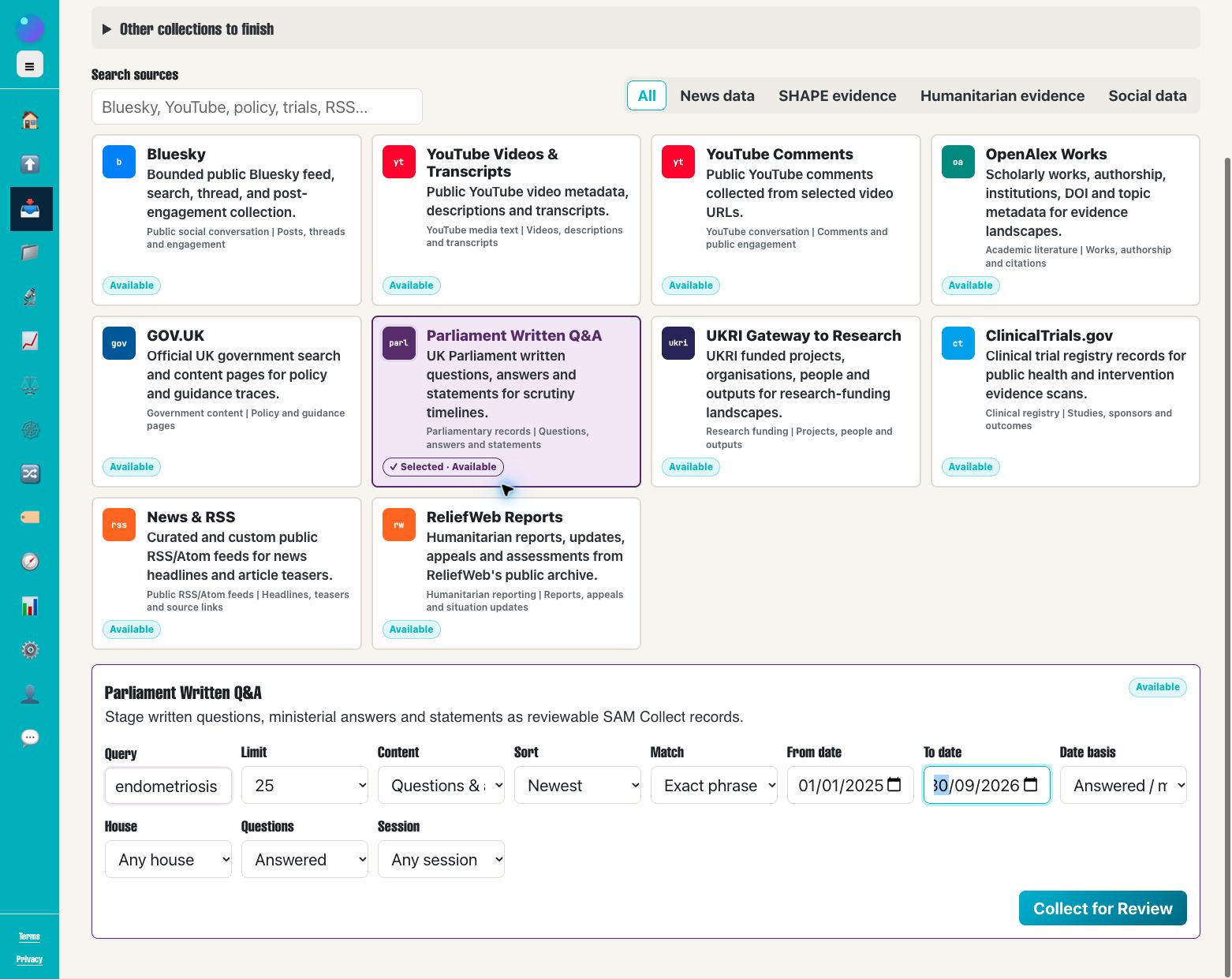
When you run Collect for Review, inspect the records returned. Save the actual query, filters, collection date, requested limit and returned count. Retain source URLs, question identifiers and dates. Use Save Snapshot to keep a selection, or Save to Analyse to add the material to My Corpora.
Read question and answer together
A single source illustrates the reading task. Written Question 109583, asked by Dan Carden and answered on 13 February 2026 by Karin Smyth, concerns diagnosis, treatment and ongoing care for people with endometriosis. Read the question alongside the reply and record who is speaking in each part.
An initial codebook might distinguish the need being raised, the action described, the organisation named and the time orientation of the statement. A proposal, an account of existing activity and an expressed expectation occupy different positions in an institutional narrative. Preserve those differences when coding or summarising.
Return to the original page when a statement is ambiguous. A dated answer is evidence of what the reply says; assessing delivery requires records appropriate to that additional question.
Extend to research activity
Use the same substantive topic to design a separate OpenAlex Works collection. Review titles and available abstracts, publication dates and identifiers. Missing abstracts affect the amount of text available for analysis. A broad search result does not establish the quality or relevance of every publication. OpenAlex describes its catalogue as a source of research records.
For UKRI Gateway to Research, select relevant funded projects and inspect their descriptions and associated information. Keep the project identifier and source link. A project description sets out funded activity and aims; use the associated outputs or further evidence when asking about completed findings. The UKRI guide to Gateway to Research explains the source and its coverage.
Write a cross-source memo
Use one row per source type: the question it helps answer, its selection boundary, its unit of analysis and the interpretation it contributes. For example, an interview may describe the effort of coordinating care; a parliamentary question may name coordination as an issue; a funded project may propose to study it. Their relationship can sharpen the research question without treating them as equivalent observations.
Export each collection with its provenance, retain source-specific code definitions and describe any comparison explicitly. This makes the thread from lived accounts to institutional discussion and research activity available for another reader to examine.