
Exploring diagnostic journeys with Pathways
18 October 2026 · Part 1 of 3
An event map offers a way to ask where journeys diverge, repeat or converge. The most useful next step is often a close reading of the records behind a route.
SAM’s built-in Endometriosis Diagnostic Delay sample contains 80 fictional cases and 540 event rows. It is a teaching dataset. Its routes, timings and outcomes describe the sample’s constructed journeys; they are not estimates of patient experience or clinical evidence.
Begin with a process question
For this exercise, ask: How do the recorded journeys move between reported symptoms, appointments and later stages, and where would we want to inspect the underlying evidence?
Start in Pathways with the built-in sample. Read the summary counts and the note about the map’s visible activities. A display can show a subset of the full structure for legibility. Keep that distinction when describing what you see.
The data have two different units: a case and an event. Several event rows belong to each fictional journey. The event log preserves a case identifier, an activity label and an ordering field. These fields let SAM construct directly following transitions within a case. A link tells you about recorded sequence; an explanation of why the transition occurred requires further evidence and interpretation.
Open a route, then open its evidence
Choose a route or filter to a case, inspect its events, and select an activity to open the evidence panel. During the walkthrough, the filtered case SYN-ENDO-001 contains three events. Selecting “Symptom start” exposes the source wording “Pelvic pain reported” and its source identifier. This gives a concrete route from a graphical element to a row of evidence.
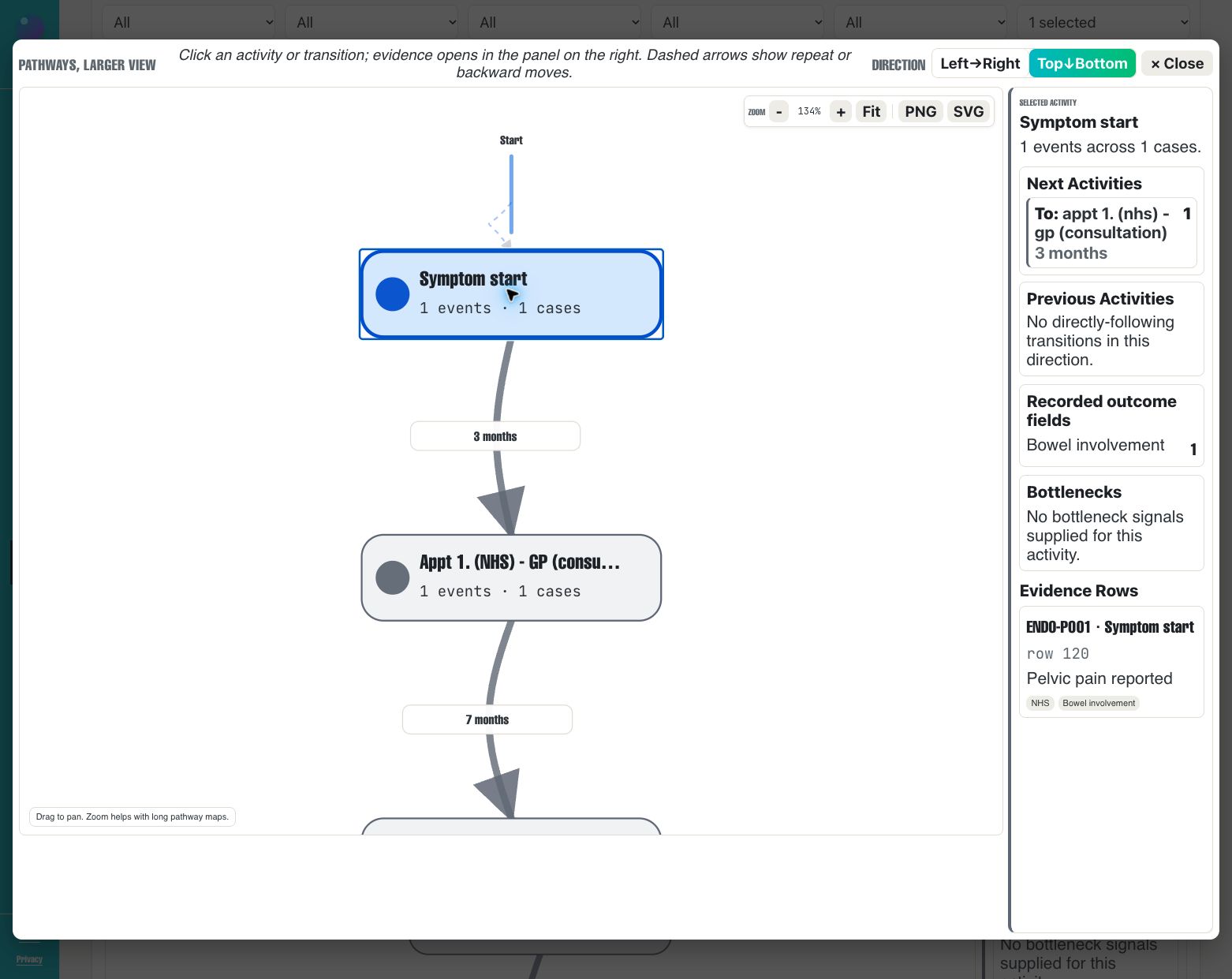
Detail view of fictional teaching data, inspected 18 October 2026. The image shows the selected event and evidence panel rather than the complete map.
Read the activity label and source wording together. An activity name is a useful abstraction, while the source row carries the particular account represented by the event. Record any uncertainty about the mapping, missing events or date meaning before making a process claim.
Inspect time with the same care
The seed data include a field labelled “Start Timestamp (Symptom when noticed - interview 2017)”. Its label already raises a methodological question about how the date relates to the account. Review the date mapping and the event order in the working dataset before interpreting durations. If ordering comes from an explicit sequence field, preserve that explanation in the methods note.
A longer displayed interval can guide a further question about the material. The event log alone does not tell you everything that happened between the recorded events. In a real study, the next reading might involve the interview, case notes or an independently documented source, within the permissions of that project.
Keep a short route memo
Write down the active filters, visible case and event counts, selected transition and supporting source IDs. Then add the interpretation you are considering and the evidence you would need to develop it. For example: “This route prompts a closer reading of how people describe moving between services. I will examine accounts of information transfer and responsibility for the next appointment.”
Export the relevant map and event evidence for discussion. Retain the full reviewed event log alongside a filtered illustration so that another reader can understand how the illustration was selected.
Continue from sequence to experience
The next article follows that question into a separate fictional interview dataset about communication, access and coordination. It demonstrates a related analytical question without implying shared participants. A future linked study could use a legitimate shared case identifier, but these teaching datasets have no such linkage.
The third article develops the wider institutional context using SAM Collect. Together, the series shows how a research question can connect process evidence, situated accounts and public records while preserving each source’s contribution.